
Affiliate disclosure: This post contains affiliate links. If you buy through them, we may earn a commission at no extra cost to you. Prices and availability change — check Amazon before you buy.
A quiet treadmill for an apartment is not a silent treadmill. The machine makes its own motor and belt noise, but your neighbors may notice the repeated footfall and vibration even more. The practical goal is not to promise invisibility; it is to choose a machine you can use at walking speeds, on a stable surface, at considerate hours, without turning the floor into a drum.
This guide covers noise sources, mats, timing, storage, and the foldable treadmill versus walking pad tradeoff. Browse foldable treadmills for apartment use on Amazon, then verify live specifications and return terms.
Quick answer: what makes a treadmill neighbor-friendlier?
- Walking-focused use: A steady walk is usually less disruptive than jogging or running.
- A firm, compatible mat: It can reduce sliding, scuffs, and some vibration, but it is not soundproofing.
- Soft footfalls and timing: Both matter more than a “quiet” badge on a listing; daytime and early evening are better than quiet hours.
- A realistic storage plan: Fold it away so it stays clear of walls, furniture, and shared paths.
If your apartment has thin floors or a particularly noise-sensitive downstairs neighbor, start by assuming that every motorized belt will be audible. That mindset leads to a better purchase than trusting a headline that says “whisper quiet.”
Where the noise really comes from
There are two different problems to solve. The first is airborne machine noise: motor hum, belt movement, rollers, beeps, and the occasional rattle. The second is structure-borne vibration: your feet and the moving deck sending repeated impacts through the floor. A treadmill can have a modest motor hum and still sound intrusive below if the user lands heavily or the floor flexes.
Read recent reviews for belt squeak, loose covers, motor pitch, low-speed rattling, and changes after several weeks. A belt aligned and maintained according to the manual is less likely to add avoidable noise. Do not lubricate or alter the machine unless the manufacturer says to do so.
Do treadmill mats actually help?
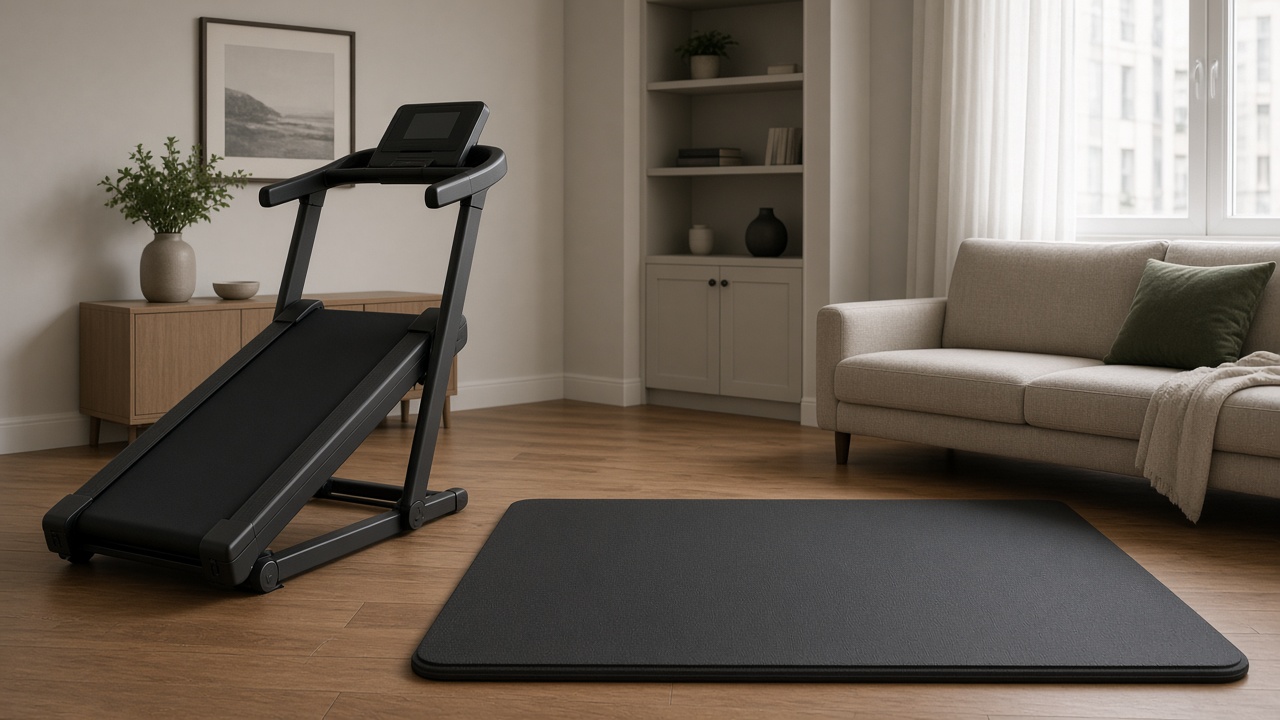
A treadmill mat is useful, but it is not a magic neighbor shield. A correctly sized mat can keep the machine from creeping, protect the floor, and provide a more consistent interface between the deck and the surface. That may reduce some vibration and rattling. It cannot erase footfall, motor hum, or the sound of a fast belt.
Shop for a treadmill mat for a walking pad or apartment treadmill that suits the machine’s dimensions and the floor underneath. Follow the owner’s manual for ventilation, carpet use, and clearance. If the unit needs airflow below its deck, do not bury it in a thick or unstable layer simply to chase quiet.
Anti-vibration mats can help when the manufacturer allows them and the surface remains stable. Browse anti-vibration mats for treadmills, but check dimensions and thickness. A soft pad that compresses unevenly may make the treadmill wobble; a firm, properly sized base is a better starting point.
Timing beats a lot of accessories
Even a well-matted treadmill is the wrong tool for a 6 a.m. sprint or a late-night run in a shared building. Test the machine at the slow walking speed you actually plan to use, then test again at the busiest part of your normal routine. Daytime and early evening are generally more considerate than quiet building hours, but your lease and building rules come first.
Start with a short session and listen from another room or the floor below if you can check safely. Ask whether the sound is a hum, a thump, or both. If vibration remains obvious, reduce speed, shorten sessions, adjust your stride, or choose a quieter activity.
Walking pad vs foldable treadmill
A walking pad vs foldable treadmill comparison is a comparison of habits and space. Walking pads are low and easy to slide under a desk or sofa. A foldable treadmill under $400 may offer a rail and vertical storage, but it generally occupies more room and can get louder as speed rises.
Neither category wins the noise question automatically. A well-built pad may be neighbor-manageable at a slow walk, while a poorly maintained pad can squeak. A foldable model can feel stable and quiet at walking speed, then transmit more vibration when used for jogging. Buy for the speed and stride you will actually use, not the maximum number printed on the box.
What to buy — and what to skip
Prioritize steady belt tracking, useful low-speed control, clear weight and speed ratings, maintenance instructions, and a home-test return policy. Confirm the open footprint, step-off space, folded dimensions, machine weight, and delivery route.
- For desk walking: Compare walking pads for standing desks with a low deck, simple controls, and a storage slot you can use daily.
- For a rail and occasional faster walking: Browse foldable apartment treadmills, then verify rail clearance and rated speeds.
- For floor protection: Choose a stable treadmill mat for your floor type, not just the cheapest large rectangle.
Skip the myth that a higher horsepower number automatically means quiet operation. Skip “silent” claims that do not explain testing conditions. Skip a treadmill that only fits when pushed against a wall, blocks a walkway, or requires a heavy lift you will avoid. Also skip running on a walking pad unless the manufacturer explicitly rates it for that use.
Simple setup checklist
- Measure the open footprint, clearance, and storage space.
- Check building rules and choose a reasonable test window.
- Use a firm, compatible surface with required ventilation.
- Walk slowly first; listen for machine noise and footfall.
- Maintain the belt as directed and store it clear of shared walls and paths.
FAQ
What is the quietest treadmill for an apartment?
There is no universal winner. A walking-focused machine used slowly, maintained correctly, and placed on a stable compatible mat is usually a better apartment plan than a budget treadmill used for running.
Will an anti-vibration mat stop noise downstairs?
No. It may reduce some movement or vibration, but it cannot remove motor noise or repeated footfalls. Test the whole setup during your intended hours.
Are walking pads quieter than foldable treadmills?
Sometimes at walking speeds, but the category label is not a guarantee. Belt condition, floor construction, user footstrike, and speed all matter.
What if even slow walking is too loud?
Use the treadmill only during an agreed window, reduce sessions, or switch to a quieter option. Our quiet full-body apartment workout is a useful belt-free alternative.
Related guides
- Walking Pad vs Foldable Treadmill for Apartments
- Best Walking Pads Under $300
- Walking Pad for a Standing Desk
- Best Foldable Treadmills for Apartments Under $400
- Quiet Full-Body Apartment Workout
- Apartment Neighbors Guide
- Equipment hub
Bottom line
The quietest apartment treadmill is usually used at a modest walking speed, on a firm compatible mat, during considerate hours. Buy for stable construction, useful controls, maintenance support, and honest storage dimensions — not a “silent” label. If the floor still carries every step, choose a different workout.