
Affiliate disclosure: This post contains affiliate links. If you buy through them, we may earn a commission at no extra cost to you. Prices and availability change — check Amazon before you buy. See our Affiliate Disclosure.
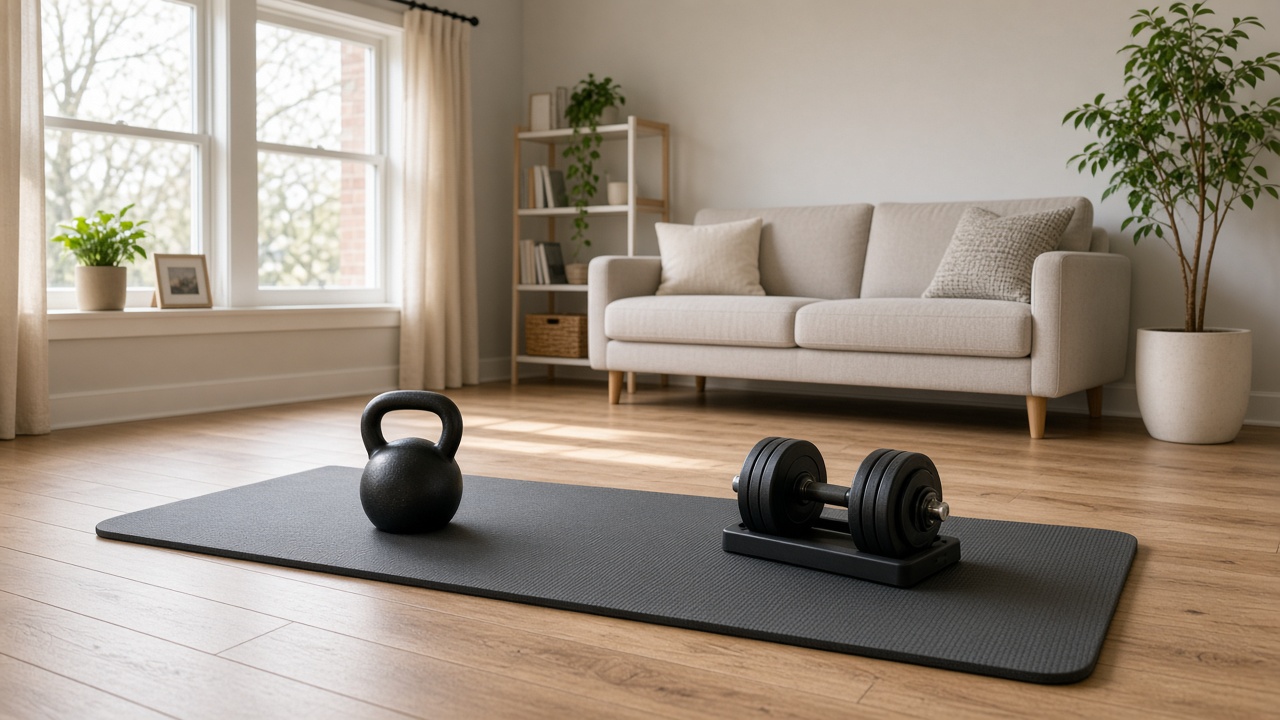
In a small apartment, the best strength tool is not the one with the most exercises on the box. It is the one you can store, use quietly, and pick up consistently. This kettlebell vs dumbbells comparison looks at footprint, noise, floor protection, storage, and the practical difference between adjustable dumbbells and fixed kettlebells.
Want a broader setup before choosing weights? Our apartment gym starter kit under $100 starts with the mat-and-bands basics. This guide is for the next decision: one compact loadable tool or a pair that can cover more movements.
Kettlebell vs dumbbells: the short answer
Buy a kettlebell if you want one compact, always-ready tool for swings, goblet squats, carries, deadlifts, and simple conditioning. Buy dumbbells if you want two-sided loading for presses, rows, lunges, curls, and gradual strength progression. For the smallest storage footprint, adjustable dumbbells usually win; for the simplest grab-and-go setup, a fixed kettlebell wins.
Quick comparison
| Factor | Fixed kettlebell | Adjustable dumbbells |
|---|---|---|
| Best use | Simple full-body patterns, carries, swings, goblet work | Presses, rows, split squats, curls, and scalable strength |
| Storage | One dense footprint; easy to park in a corner | Small when stored on its base, but needs space for trays or plates |
| Noise risk | Low when set down gently; swings can thump if rushed | Plates, dials, and collars can clack; never drop them |
| Adjustment | None; buy another bell to add load | Change load between exercises; selector or spinlock styles differ |
| Apartment drawback | One weight may be too light for legs or too heavy for presses | Longer shape and moving parts need careful set-downs and storage |
Noise, floors, and neighbor reality
Neither option is silent. The loudest moments are usually the weight touching the floor, plates shifting, or a tired set-down. Use a dense mat on hardwood, keep the weight close to the floor, and place it down instead of dropping it. Check material and floor compatibility, especially on finished wood or vinyl.
- Fixed kettlebell: It is less likely to rattle, but swings need a clear lane and controlled finish. Skip them if the room or neighbors make the setup questionable.
- Adjustable dumbbells: Selector mechanisms and spinlock plates can click during changes. Change weights over the mat and keep the handles from rolling into walls.
- Timing: Quiet hours favor floor presses, rows, and controlled squats over fast swings.
- Mat choice: A mat cushions contact and protects the floor; it does not make dropping weights acceptable. See our yoga mats for apartments under $50 guide for a starting point.
Storage: one bell vs a changing dumbbell set
A fixed kettlebell needs a stable floor-level home and a clear path around it. That simplicity is valuable when your “gym is also a living room; do not place a heavy bell on a high shelf.
Adjustable dumbbells save space compared with a rack of fixed pairs when their trays stay together. Selector models are tidy and fast; spinlock kits cost less but need room for plates and collars. Measure stored length and height, not just the handle.
Adjustable dumbbells vs fixed kettlebells
A fixed kettlebell has fewer failure points and no adjustment ritual: grab it and train. It suits goblet squats, deadlifts, carries, rows, and floor presses. Its limitation is load matching: one bell may be too demanding for presses or too light once your legs adapt.
Adjustable dumbbells solve that mismatch: use a lighter setting for presses, then add load for rows, Romanian deadlifts, and split squats. The mechanism deserves care. Keep them in their trays while changing weight, follow the limits, and never drop them. Our adjustable dumbbells under $200 guide covers selector vs spinlock choices and small-space storage.
Who should buy what?
Choose a fixed kettlebell if…
- You want one simple tool that is ready without changing plates.
- Your routine centers on goblet squats, deadlifts, carries, rows, and controlled swings.
- You have very limited storage and prefer a single stable base.
- You will train at quiet hours and can skip impact-heavy swings when needed.
Browse fixed kettlebells on Amazon
Choose adjustable dumbbells if…
- You want one pair to cover lighter upper-body work and heavier lower-body work.
- You plan to progress load over time instead of buying another bell soon.
- You use presses, rows, lunges, floor presses, and Romanian deadlifts more than swings.
- You can store the pair on a tray and commit to quiet, controlled set-downs.
Browse adjustable dumbbells under $200 on Amazon
Consider starting lighter if…
You are new to loaded training, live above noise-sensitive neighbors, or cannot make a clear lifting lane. Start with a mat, bodyweight, or bands and learn the movement patterns first. A quiet full-body apartment workout can build consistency before you add a weight that needs more space and control.
Apartment buying checklist
- Measure the storage spot, the mat footprint, and the clear space around your body.
- Read recent reviews for rattling, loose plates, chipped coatings, and slippery handles.
- Prefer a flat, stable base and a coating that will not mark your floor; still use a mat.
- Check the return policy and keep packaging until the weight feels stable in your actual room.
- Choose the load you can control for every planned movement, not the heaviest number in the listing.
FAQ
Is a kettlebell or dumbbell quieter?
Usually a fixed kettlebell has fewer parts to rattle, but either can be quiet with controlled reps and a mat. Swings and dropped weights create more impact than the tool itself.
Is one kettlebell enough for a full-body workout?
It can cover squat, hinge, push, pull, carry, and anti-rotation patterns. Progress may eventually require a second weight, especially if one bell is awkward for presses.
Are adjustable dumbbells safe on hardwood floors?
They can be, if you use a compatible mat, set them down gently, and follow the product’s handling instructions. Never drop them or drag plates across the floor.
Should beginners buy adjustable dumbbells?
They can, but start at the lightest manageable setting and learn the movement before adding load. If the mechanism feels unstable or confusing, a fixed light kettlebell or bands may be the simpler first step.
What other apartment gear pairs well with weights?
A mat is the first add-on. Bands give you quiet warm-up and accessory work, while a compact foam roller for apartment recovery can fit beside the same storage corner. For cable-style pulls without heavy weights, see our door-anchor band sets.
Related guides
- Best Adjustable Dumbbells for Tiny Spaces Under $200
- Apartment Gym Starter Kit Under $100
- Best Yoga Mats for Apartments Under $50
- Best Foam Rollers for Apartment Recovery
- Best Door-Anchor Resistance Band Sets
- Equipment hub
Bottom line
Choose a fixed kettlebell for the simplest one-tool setup and choose adjustable dumbbells for more precise progression across upper- and lower-body exercises. In either case, measure first, train on a protective mat, keep the weight off the floor with controlled set-downs, and match the tool to your neighbors and storage reality. More practical apartment gear lives on the equipment hub.